One month out
Since it’s been another season of learning, I thought I’d share how the journey has been so far: the good, the bad and the surprising.
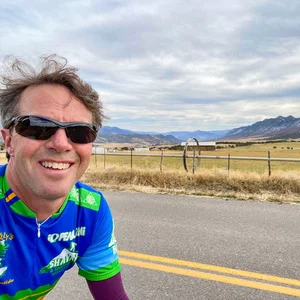
For those of you new to the story, this is my final year of real racing, so I’ve focused all the training and energy to success at Gravel Nationals on September 12 in La Crescent, MN. The main difference for this year when compared to previous campaigns has been the mandatory acquisition of speed- where do you get it, how do you develop it and why does it have to hurt so much to garner it? Since late January, I’ve been using an AI inspired software training program called TrainerRoad to dial in the lacking portions of my riding, doing my best to follow what I’m supposed to be doing and trusting that the outcome will follow the work involved. I’ve just passed 3,000 miles for the year, have already participated in 5 events to test where the fitness is, done my best to manage all the remaining elements of normal life while supporting Misti’s endeavours as she broadens for planetary granola takeover.
So, how’s it going?
To be honest, for the first five months I thought I was totally wasting my time, money and year.
Coming into this challenge I felt I had a pretty deep well of fitness and form to pull from, and that I would be able to use the past few years of long miles and steady tempo work to build a pretty tall pyramid of speed. The pervasive issue, however, was that I wasn’t making much progress and seemed to be getting worse in all aspects.
For those of you who haven’t yet dabbled in “training”, speed work is primarily about intervals. Intervals are workouts related to something called your functional threshold power (FTP), the line at which your metabolism shifts from aerobic respiration to anaerobic respiration. Below your FTP line, your body can maintain the workload indefinitely for as long as it can be fueled. Above the line, your muscles start calling for more oxygen than your body can provide, so this amount of work will deplete you quickly, and leave you pretty empty for a period of time afterward. The higher above the line you go, the bigger the fall (without fuel).
Interval training is useful in several ways but primarily primes your body to switch back and forth between aerobic and anaerobic, teaching you how to manage the suffering, and slowly pushes your FTP number higher so the amount of work your body can do increases without going into overload.
For those of you that have experience, you will recognize this as a rather basic approach- with the advent of precisely measured outputs, refining exactly what each rider is capable of and putting that into a training program is what any good coach can do. Unfortunately, I don’t have that kind of money to spend, nor, honestly, do I have that kind of desire to achieve my goal. While I would like to keep a coach in business, I really wanted to find out what could be done with a program that costs $21/mo, an experiment I could rationalize to try and achieve a top 20 in my age group at nationals, improving 13 spots over my last attempt two years ago.
So, what was going wrong all spring?
The short answer is that I didn’t have the settings correct on my program. All spring long I was doing short rides that would push my heart rate and power output up and down the range, teaching my body how to shift back and forth, but not really building my endurance. Each ride is given a training stress score (TSS) and from February- end of May, my weekly TSS averaged around 200-250 for the 3-4 planned rides/week I was sticking to. An hour of riding at FTP receives a score of 100, if you ride at 55% of your FTP (easy/zone 1) your TSS is 35, the vaunted zone 2 is 65-70% of FTP and TSS of 42-49. So, the training rides were giving my metabolism a lesson, but the trouble emerged when I would try to ride more than a couple of hours- my body would basically cramp and quit when I hit 4 hours. Add to that my FTP was not progressing- Jan 27 it was 193, then up to 207 a month later, then 210, 210 again in April, 215 in May, then 214, now 207. Did it stabilize at my limit or did I screw it up when I got bored with the short rides?
May 30 was the first big test I did — Unbound, and it was a wild experience, with a TSS of 481 for that day alone. Two other similar 100 mile events give it relevance- Bozone three weeks later had a TSS of 467 while the Foco Fondo in July was only 381.
Numbers and metrics. I quit “training” and just started riding, for the joy and love of it — mostly because everything was turning into numbers. It’s way worse now. “But numbers are actually your friend”, maybe not my friend but I now treat them as a neighbor I don’t really like that much but have to learn how to get along with.
Of the three 100 mile races I have done this year, Unbound was going pretty good until the last 20 miles when the lights went out and I suffered mightily to get to the line. Bozone I lasted until about mile 95 and then completely ran out of gas, again. Foco was different- I raced the whole way and instead of finishing well back in the pack, I was a very respectable 21st, never running out of gas and regretting I let the two guys go on the final rise because I never envisioned battling for 20th, and they weren’t in my age group, so why bother. The mental game of racing is another topic to cover in the future.
Two things changed from the first races to the third- right after Bozone I found the place in the app that let me adjust the volume of training. Somehow when I signed up I didn’t do it correctly because I limited the amount of time I could spend on the bike. I clicked the button that adjusted it based on what the computer thought I “should” be doing and the program went from 3 days a week of riding to 5, my weekly TSS went from 250 to 400. My fitness has significantly improved even if my FTP has not gone up (although my predicted FTP is jumping to 220 next week, maybe).
The second change is that I have come to the realization that my gravel bike is dreadfully slow. While I now use it for training and adventures, racing is now going to be done on my road bike, with the biggest tires it can fit. I know for certain that is what made the most difference in Foco, and primarily why the TSS was so much lower- my road bike bike requires much less power to make it move forward and that, over the course of 100 miles, adds up dramatically.
One month to go and we are nearly there. Where, maybe the numbers can predict, but the finish line is definitely in sight, efficiency needs to be kept high and belief solid.
Cheers